
XXI ISA World Congress of Sociology
Conference Format

The XXI ISA World Congress of Sociology will be held in person only. All sessions and presentations are expected to take place on site in Gwangju, Republic of Korea. No online participation will be possible.
2.1 Session Allocation and Time Structure
The number of sessions allocated to each RC/WG/TG is determined by the number of ISA members in good standing in the respective group as of October 31, 2025. The allocation table for the XXI ISA World Congress of Sociology is presented as follows: below.
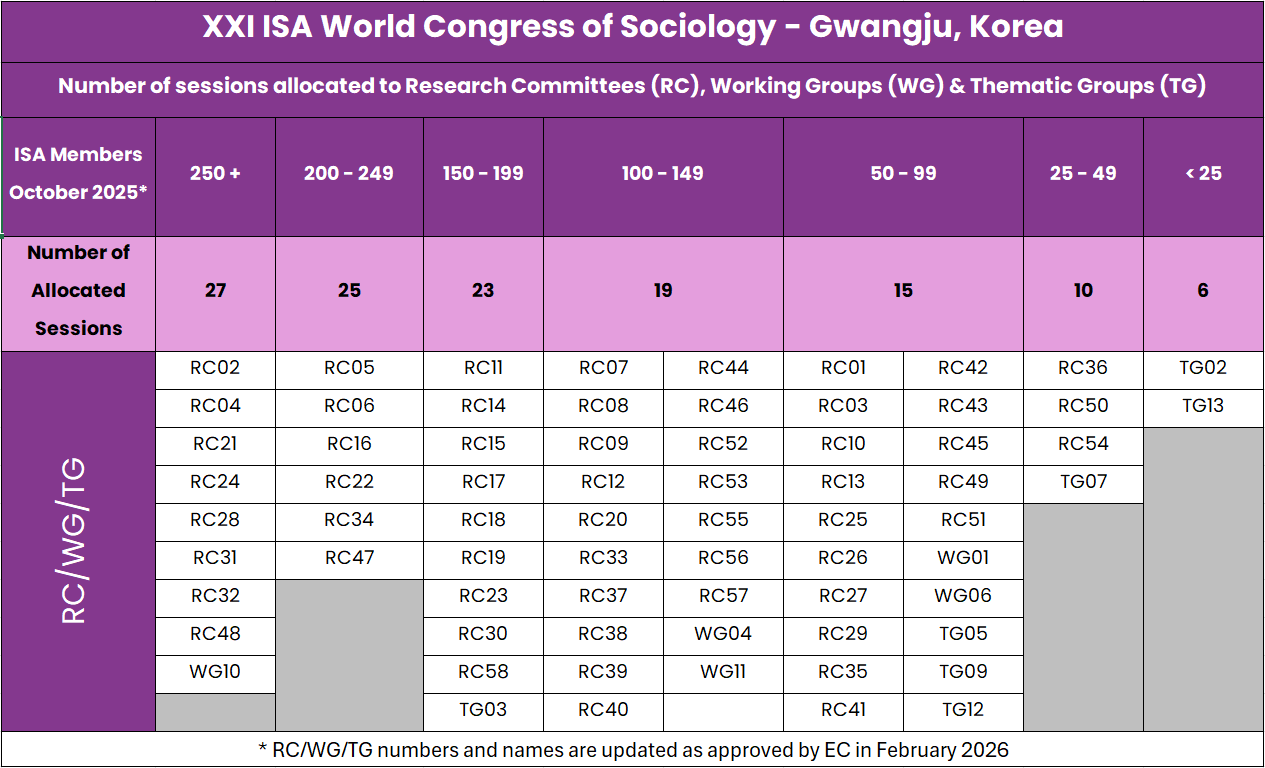
The number of sessions indicated in the table represents the total number of sessions allocated to your RC/WG/TG. This total must be distributed across all session types (Open, Invited, Joint, Roundtable, Poster, as well as the Business Meeting).
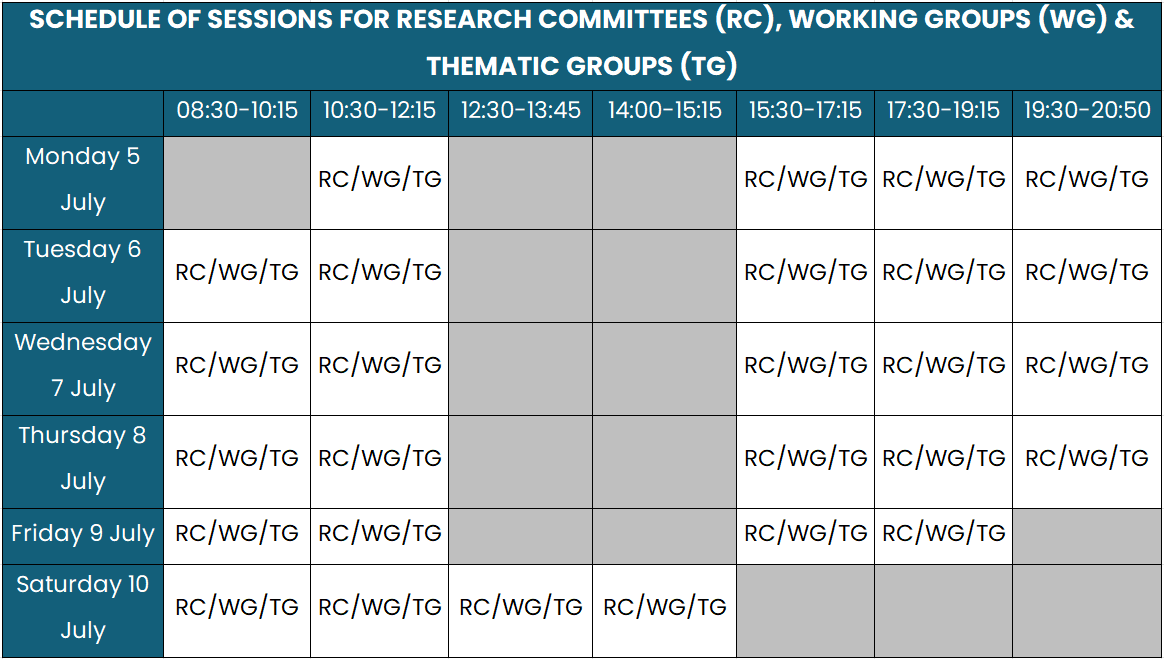
All sessions of Research Committees (RC), Working Groups (WG), and Thematic Groups (TG) will last 1h 45 min [105 minutes], except for the 19:30-20:50 evening time slot, which lasts only 80 minutes and is recommended for the Business Meeting.
The available time slots for session scheduling are presented below. Programme Coordinators schedule Open and Invited sessions within the available time slots. Roundtable, Poster, and Joint Sessions are scheduled centrally by the Conference System. Further details on the scheduling process are provided in the Duties and Deadlines section.
2.2 Types of Sessions
Sessions within the RC/WG/TG programme may take different formats. The type of session must be indicated at the time of proposal submission.
The following types of sessions are possible:
Open Sessions (Paper Presentation Sessions)
Open Sessions are included in the Call for Abstracts and are open to receive abstract submissions. Session organisers evaluate and select the abstracts to be included in their session.
Open Sessions are normally structured as Paper Presentation Sessions. It is recommended that each session use its 105 minutes to accommodate 4 to 5 papers and 15-20 minutes of collective discussion.
Further details on abstract selection, distributed papers, and presentation allocation are provided in the Duties and Deadlines section.
Invited Sessions
Invited Sessions are organised with a pre-defined list of participants. They are not included in the Call for Abstracts and are not open to receive abstract submissions from the general public.
Invited Sessions may take different forms, including but not limited to:
• Featured or Keynote Speaker Sessions, centred on a presentation by a leading scholar, followed by discussion;
• Panel Sessions, involving structured debate among invited panellists on a specific theme, followed by an open floor;
• Author Meets Their Critics sessions, organised around a discussion of a recent publication.
The above are simply suggestions. Other formats, such as a hands-on workshop or a session on pedagogy, may also be appropriate for your group.
Poster Sessions
Poster Sessions present research in a visual format and are scheduled centrally within the Congress timetable. Presenters showcase their work during a designated time slot, allowing for one-on-one discussions with participants. Each RC/WG/TG can organise up to 2 Poster Sessions.
Roundtable Sessions
Roundtable Sessions are a format used to accommodate a larger number of accepted abstracts within a single session time slot. In a Roundtable Session, multiple small-group discussions take place simultaneously in the same room, with up to five tables running in parallel. Each table includes a limited number of presenters (typically 5–6) and participants (up to 10), and is organised around discussion rather than sequential formal presentations. Tables within a session may address the same topic or different topics.
Roundtable Sessions are not typically proposed at the Call for Sessions stage. They are usually designated later in the programme-building process, when a session receives a high number of quality abstracts.
Further details on when and how Roundtable Sessions are designated and organised are provided in the Duties and Deadlines section. Each RC/WG/TG can organise up to 2 roundtable sessions.
Joint Sessions
Joint Sessions are organised collaboratively by two or more RCs, or by an RC together with a WG or TG, on a theme of shared interest.
Joint Sessions require coordination between the participating units and are included within the session allocation of the host RC/WG/TG. They count only toward the allocation of the host unit. Joint Sessions may not represent more than 50% of the total number of sessions in which a RC/WG/TG is involved, whether as host or co-organiser.
Scheduling of Joint Sessions is handled centrally and cannot be modified by Programme Coordinators.
Business Meeting
Each RC/WG/TG must hold one Business Meeting during the Congress. This session is reserved for governance and organisational matters and counts toward the allocated session total.
2.3 Linguistic Diversity
The ISA has three official languages: English, French, and Spanish. English is the administrative language of the Association.
Abstracts may be submitted in any of the three official languages. The language(s) in which abstracts are accepted for a session indicate the language(s) in which the session will be conducted. For Open Sessions, Session Organisers must specify, at the time of proposal, which of the official languages will be accepted for abstract submission.
Participants may present in any of the three official languages. Session Organisers are responsible for defining the working language(s) of their session and should ensure that this is clearly indicated in the session description and, where relevant, reflected in the session title.
The ISA does not provide simultaneous interpretation. Where participants do not share the same working language, Session Organisers may, where appropriate, plan simple arrangements to facilitate communication within the session.
Possible approaches may include, for example, the use of bilingual presentations or slides, brief summaries in another language, or informal support among participants. Any such arrangements should be communicated in advance to both presenters and the audience.